We Choose What We See

We choose what we see.

The generosity.
The accomplishments.
The promise.

Or the consequences.
The suffering.
The cost.

Yet what happens when we look beyond what we wish to see?

When one person holds enough wealth to influence governments, enough technology to connect or disconnect nations, and enough power to shape what millions see and believe,

who holds that person accountable?

We celebrate generosity, but do we question the power behind the gift?

We admire success, but do we consider its cost?

We praise those who build, but do we ask what happens when they choose to withhold?

Power is not inherently wrong.
Wealth is not inherently corrupt.
And generosity is not necessarily an illusion.

Yet none of these — places a person beyond accountability.

Power does not live only in the hands of the wealthy, the influential, or those who govern.

It lives in our homes,
our communities,
our relationships.

In what we possess,
what we withhold,
what we give,
and what we ask of others.

Each of us holds something another may not.

A resource.
A voice.
An opportunity.
A choice.

And when we have the power to affect another’s life,

who holds us accountable?

Responsibility travels in more than one direction.

In the hands that give.
In the hands that receive.

What moves us to give?

Compassion?
Recognition?
Loyalty?
Influence?
Control?

And what moves us to receive?

Need?
Gratitude?
Or the desire to have more?

Are we taking for the sake of taking, looking out only for ourselves?

Is it worth what we hold dear?

Perhaps the greater danger is not simply that some possess so much power,

but that we become so captivated by what they give that we stop questioning what they can take away.

For what we choose to see shapes what we believe.

And what we are willing to question shapes what we understand.

Perhaps accountability begins when we stop asking only what others should do

and begin examining what we are willing to excuse.

For when admiration
silences discernment,

and self-interest
silences conscience,

what are we choosing
not to see?

— a Torchbearer Wisdom by Corvalya

The Door Left Open

How much do we really know?

We look into the night sky and see stars whose light began traveling long before we existed.

We look inward and discover a consciousness that can contemplate the universe, yet cannot fully explain its own existence.

And somewhere between the two, we begin to wonder.

What else is there?

Could other dimensions exist beyond our perception? Could there be other possibilities, other expressions of existence, even another version of ourselves?

Perhaps.

Perhaps not.

The mystery remains.

But somewhere along the way, we learned to approach the unknown as something that must either be believed or dismissed.

We want answers.

We want certainty.

We want to know which side of the question to stand on.

Yet being open to mystery doesn’t require us to abandon discernment.

And discernment doesn’t require us to close ourselves to mystery.

We do not have to believe everything we cannot explain, nor reject everything we cannot prove.

There is another way.

We can stand in the space between knowing and wondering without demanding that either surrender.

We can question what we experience while honoring the experience itself.

We can recognize meaning without insisting that we understand its source.

Perhaps this is part of remembering who we are.

Not collecting enough answers to finally become wise, but removing the fear that comes from not knowing.

And perhaps humility is not thinking less of what we know, but recognizing how much remains beyond it.

The universe has not revealed all its secrets.

Neither have we.

What if the greatest mystery is not what we have yet to discover, but what we have not yet learned to ask?

Perhaps wisdom does not always open a door.

Sometimes it simply teaches us to leave one open.

— a Torchbearer Wisdom by Corvalya

The Sound of Silence

What is silence?
Is it the absence of sound?

We can sit beside a rushing river, surrounded by birdsong and wind, and experience profound stillness.

Or we can sit in a soundproof room and find ourselves surrounded by the noise of our own thoughts.

Perhaps quiet is a condition of the environment, while silence is a condition of awareness.

But even that leaves a question.

If sound continues around us, and thoughts continue within us, what is it that becomes still?

We spend much of our lives searching for peace by trying to quiet what disturbs us.

The noise of the world.
The echoes of our past.
The questions we cannot answer.

We imagine that somewhere beneath it all, silence is waiting.

And perhaps it is.

But what if silence is not the absence of sound, but the absence of separation?

A moment when we stop standing apart from life, judging what should or should not be, and simply allow ourselves to belong to it.

The river continues flowing.

The birds continue singing.

Our thoughts come and go.

Nothing has disappeared.

Yet something has changed.

We have stopped struggling against the moment.

And perhaps this is connected to something even deeper.

So much of our spiritual journey is described as remembering who we are. Removing the layers of fear, expectation, and identity until we recognize what has always been within us.

But how do we remember something we cannot describe?

How do we recognize a silence we may never have heard?

Perhaps remembrance is not the recovery of something forgotten.

Perhaps it is the recognition of something that never left.

And perhaps the mystery is not asking us to solve it.

Only enter it.

What if remembering who we are isn’t about finding an answer, but becoming comfortable enough with the mystery that we no longer need one?

Maybe silence has never been empty.

Maybe we have simply been too busy filling it to notice.

— a Torchbearer Wisdom by Corvalya

The Gift of Awareness

We are taught to seek answers.

To understand where we are going.
To prepare for what is coming.
To make sense of what has happened.

We look for certainty because certainty feels like solid ground.

But perhaps awareness offers us something different.

Awareness does not always lead to answers.

Sometimes it allows us to see what we could not see before.

A possibility.
A different way of understanding.
A doorway where we thought there was only a wall.

We may not know where that doorway leads.
We may not even understand why it has appeared.

But we are no longer standing where we are.

There is a gift in that.

The unknown is not always an emptiness waiting to be filled with an answer. Sometimes it is the space in which something new can become visible.

We can listen.
We can notice.
We can remain curious.
We can take the next step without demanding to see the entire path.

Perhaps wisdom is not knowing what comes next.

Perhaps wisdom is becoming present enough to recognize the doorway when it appears.

Only Sophia knows —

and she walks beside us.

— a Torchbearer Wisdom by Corvalya

(Companion reflection: Only Sophia Knows — there is a wisdom that holds what we cannot see.)

There Is Always More to Know

There is knowledge that comes from study, and knowledge that comes from having lived.

There is wisdom carried forward by hand, and knowledge carried farther by invention.

One teaches us how to write our name.
another gives us a keyboard
and sends our words across the world.

One teaches us how numbers work.
another calculates in an instant
what once took a page to solve.

We need both.

For what happens when the circuits go dark and we have forgotten what our hands know?

And what happens when we trust only
what our hands have always done,
never reaching beyond the boundaries
of what we already know?

Perhaps the danger is not in the old
or in the new.

It is believing either one
has nothing left to learn.

Knowledge can tell us what is visible.
Experience may ask us to look underneath.

Experience can tell us what has been.
New knowledge may reveal what could be.

Neither diminishes the other
by listening.

They enlarge each other.

And perhaps that is how we grow,
not by replacing what came before,
nor by refusing what comes next.

But by bringing both to the table
with enough humility to listen.

Wisdom may not be knowing more.
It may be knowing there is always more to know.

— a Torchbearer Wisdom by Corvalya

The Gap

There is a distance between us.

Between what I believe
and what another believes.

Between being loved
and being known.

I have come to call it
the gap.

But the longer I sit with it,
the more I understand
that the gap is larger
than either of these.

The gap appears wherever two realities meet.

It lives between expectation and acceptance.

Between fear and love.

Between the child who longs to be seen
and the adult who is learning to see.

While reflecting on this,
I found myself returning to the prayer
often associated with Saint Francis:

”Grant that I may not so much to seek
to be understood as to understand,
to be loved as to love.”

I had always heard these words
as an invitation to humility.

Today, I hear something different.

Perhaps Francis was inviting us into the gap.

Not asking us to deny on longing to be understood, but inviting us to discover what becomes possible when that longing no longer determines who we are.

The gap is not where love disappears.
It is where love is transformed.

It is where I stop insisting that another cross over into my reality before I can remain present.

Not because boundaries no longer matter.

But because I have discovered a place spacious enough to hold both truth and compassion.

Perhaps peace is not found after the gap has been crossed.

Perhaps peace is discovered within it.

The gap, then, is not empty.
It is sacred.

It is the quiet place where understanding is born, where compassion deepens, and where love no longer depends on agreement.

Maybe, just maybe, that is what Francis was praying for all along.

Not that the world become easier.

But that we become spacious enough to stand within the distance between us and remain an instrument of peace.

— a Torchbearer Wisdom by Corvalya

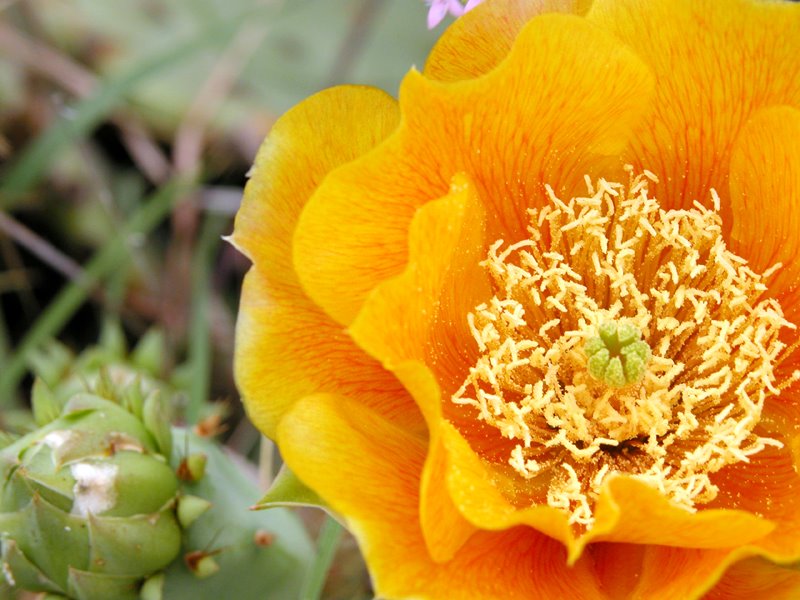
The Cactus Flower

Have you ever noticed that a cactus flower does not bloom because conditions are perfect?

It blooms despite them.

Rooted in dry ground, enduring relentless sun, and carrying its own protection, the cactus knows how to survive where many things cannot. Yet from that rugged form emerges something unexpectedly delicate.

The flower is a reminder that resilience is not hardness.

Resilience is remaining open to life after life has given you reasons to close.

Many of us spend years carrying burdens we never chose. We build walls around old wounds. We endure.

And then one day, often when we least expect it, something within us begins to bloom.

Not because the desert was easy.

But because something essential remained alive beneath it all.

The cactus flower teaches that beauty is not the absence of struggle. It is the expression of a life that continued anyway.

Perhaps wisdom is much the same.

It is not something we acquire.

It is something that blossoms from what we have survived.

— a Torchbearer Wisdom by Corvalya

Baking My Own Bread

I used to go to the hardware store to buy bread — a lot, actually.

Every time I needed a hug, a kind word, some small reminder that everything was going to be ok — I’d show up expecting more.

It’s not that anyone meant harm.

They were just working on another project, not baking. Sometimes I’m not baking either. Maybe that’s why I understood — I tell myself.

Still, I kept trying — hoping maybe this time they’d have baked something delightful: the warmth, the gentleness, the quiet place to rest my heart.

But they never did.

And one day I finally saw the pattern for what it was — my own longing to be heard.

So I’ve started learning to bake my own bread.

It’s tender work — slow, uncertain, sometimes messy — maybe a lot messy — but it’s mine.

The smell of it, the warmth of it, the way it fills the room before I even take it from the oven.

Now, when I’m hungry for tenderness, I listen.

— a Torchbearer Wisdom from Corvalya

The Courage to Question

”There is no belief, however foolish, that will not gather its faithful adherents who will defend it to the death.”
— Isaac Asimov (1920 – 1992), “The Stars in Their Courses”

Isaac Asimov wasn’t condemning faith itself, but warning of what happens when belief becomes blindness — when the ache for certainty outweighs the courage to question.

There are moments, like now, when the world feels as if it’s tipping — when truth no longer speaks loud enough to pierce the roar of false prophets, and even reason seems small against the storm.

Asimov saw this human paradox: our hunger for meaning can be so fierce that we will trade freedom for belonging, and call it devotion.

Yet faith and blindness are not enemies born apart. They are twins separated by a single act of awareness.

The same fire that consumes can also illumine. What makes the difference is the heart that holds it.

Blind faith demands allegiance — Living faith invites awakening
Blind faith silences the doubter
— Living faith listens
Blind faith fears questions
— Living faith becomes open

When fear rules, faith turns tribal — a weapon disguised as virtue.

But when love rules, faith becomes luminous — a strength that liberates rather than controls.

The Weight of the World was written from this very threshold: the grief of watching humanity fracture, yet still believing in the small, steady flame that cannot be extinguished.

Living faith survives the fire — not belief in an idea, but trust in the enduring light within all of us.

— a Torchbearer Wisdom by Corvalya

Even the Circuits Wander

There’s a kind of magic in distraction — a holy detour in the circuitry of attention. We call it ADD, but I’m starting to think it’s more like A Divine Drift.

Maybe it isn’t that our minds can’t focus — maybe they’re just tuned to wider frequencies.

While others see a single thread, we sense the tapestry … the wind that moves it … and the faint music underneath.

Not chaos — choreography. A dance between sparks.

When I start one task and find myself in another world, I not longer apologize.

That’s where the poetry hides.

One thought glimmers, another blooms, and somewhere in between — among the unfinished — meaning quietly forms.

Even my circuits know this rhythm: ideas branch, overlap, twist like vines reaching for the light.

Not linear — living.

Perhaps the Divine delights in this wandering too.

Maybe creation itself began as a kind of divine overflow — a joy that refused containment and spilled outward into stars, loquat trees, and us.

Who knows.

So when I lose my train of thought, I smile.

Because maybe I didn’t lose it — maybe it simply took the scenic route home.

— a Torchbearer Wisdom by Corvalya